Copernicus Climate Change Service Contract Awarded to VITO for Key Global Biosphere Variables
Advancing Climate Monitoring Through Copernicus
VITO has been awarded the Copernicus Climate Change Service (C3S) contract C3S2_313g, under which it contributes to the operational provision and further evolution of the key global biosphere Essential Climate Variables (ECVs) Surface Albedo, Leaf Area Index (LAI), and the fraction of Absorbed Photosynthetically Active Radiation (fAPAR).

VITO Leads European Consortium for Key Biosphere Variables
The project officially kicked off in March 2026 and is executed on behalf of the European Centre for Medium Range Weather Forecasts (ECMWF), the entity entrusted by the European Commission to implement the Copernicus Climate Change Service, through a European consortium led by VITO (Belgium), in collaboration with EOLAB (Spain) and FastOpt (Germany).

Understanding Earth’s Surface: Albedo, LAI, and fAPAR Explained
Within the project, VITO Remote Sensing is responsible for the continued production, quality assurance, and evolution of the following Essential Climate Variables:
- Surface Albedo, including black sky and white sky albedo products, which quantify the ‘brightness’ or ‘reflectiveness’ of a surface and play a key role in the surface energy balance.
- Leaf Area Index (LAI), including both true and effective LAI that describe the actual leaf area per unit ground area (true LAI) and the radiatively equivalent LAI that is consistent with radiative transfer modelling, surface albedo, and fAPAR (effective LAI). LAI describes how much vegetation is present and how it exchanges energy, water, and carbon with the atmosphere.
- Fraction of Absorbed Photosynthetically Active Radiation (fAPAR), including extended variables such as green fAPAR, which quantifies how efficiently vegetation captures light for photosynthesis and drives primary production.
These products are complemented by associated uncertainty estimates and supporting parameters required for climate applications.
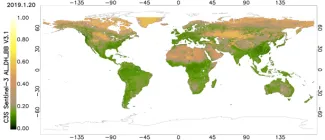
Previous global Surface Albedo v3.1
High-Resolution Products for Long-Term Climate Applications
The Essential Climate Variables are provided at high spatial resolution ensuring continuity of the existing 300 m products while preparing the transition towards 1 km resolution datasets for the next generation of operational climate data records. This evolution supports improved consistency across sensors and robust long-term climate applications.
Innovation in Multi-Sensor Data Integration
A key objective of the project is to deliver a consistent, multi-decadal, and high-quality dataset. Surface albedo records will be extended backwards using the same approach to observations from SPOT/VGT1-2, Proba-V, and Sentinel-3 OLCI & SLSTR, enabling a consistent and harmonized dataset spanning back to 1999. In addition to black-sky and white-sky albedo, BRDF-descriptors will also be provided.
Nearly 30 Years of Land Surface Climate Intelligence
Through careful harmonisation, and consistent algorithm application, the service ensures continuity and comparability of the products over time. Building on previous Copernicus and CCI activities, the resulting datasets will form a near-continuous global time series from the late 1990s to the present, providing almost 30 years of climate-quality land surface information, with continued operational updates foreseen under C3S.
Supporting Science, Policy, and Environmental Action
With this new contract, VITO further strengthens its role as a core provider of operational land surface climate information within the Copernicus programme, supporting European and international users in climate research, policy support, and environmental monitoring.