Hyperspectral Excellence: VITO's Journey
In a world where understanding our planet is more critical than ever, hyperspectral imaging is emerging as a game-changing technology. From tracking climate change to monitoring biodiversity and enabling smarter resource management, its potential is vast. But unlocking that potential requires more than advanced sensors; it demands deep expertise in calibration, processing, and data analysis.
This is where VITO Remote Sensing stands out. Over the years, hyperspectral imaging has evolved from an experimental airborne capability into a powerful space technology that is transforming how we observe our planet. At VITO, we have not just witnessed this evolution; we have actively shaped it. From developing airborne instruments to enabling next-generation space missions, we have built a strong legacy in hyperspectral calibration, processing, and application development. Today, this expertise positions VITO as a trusted partner for future Earth Observation (EO) missions.
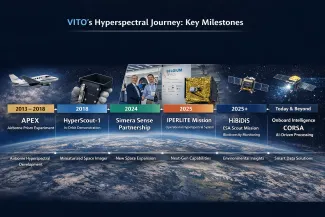
APEX: Where It All Started
VITO’s hyperspectral journey began with APEX (Airborne Prism EXperiment), one of Europe’s most advanced airborne hyperspectral imaging systems. APEX was far more than an instrument; it was a cornerstone for developing reliable calibration and processing methodologies.
Operating in an airborne environment allowed scientists to explore hyperspectral data in depth while refining radiometric and geometric correction techniques. This early work laid the foundation for everything that followed: robust calibration pipelines, high-quality data processing, and a deep understanding of hyperspectral signal integrity.
HyperScout-1: In-Orbit Demonstration
In 2018, we took a major step into space with HyperScout-1, a compact hyperspectral imager that redefined what was possible. Designed as a “small box with a big brain,” HyperScout-1 combined sensing and intelligence within a highly miniaturized platform.
Thanks to our expertise, the instrument delivered high-quality, calibrated data despite its size. Just as importantly, it introduced a new paradigm by bringing processing capabilities closer to the sensor. This mission marked a turning point, demonstrating that hyperspectral imaging could be both powerful and efficient in space.
IPERLITE: From Demonstration to Operational Impact
The IPERLITE mission, launched at the end of November 2025, represents a major step forward. More than a continuation of previous efforts, it marks a clear transition toward operational, high-impact hyperspectral systems.
Building on decades of experience, VITO plays a key role in ensuring that IPERLITE delivers high-quality, reliable data from the start. At the core of this contribution lies advanced calibration and processing, transforming raw Level-0 measurements into trusted, application-ready information.
What makes IPERLITE particularly significant is its shift from technology demonstration to mission readiness. Hyperspectral data is no longer experimental, it is expected to perform consistently, at scale, and in support of environmental monitoring and operational services.
IPERLITE represents the consolidation of years of expertise, from airborne campaigns to spaceborne missions. It brings together proven calibration approaches, mature processing pipelines, and a deep understanding of data quality, reinforcing VITO’s role as a key enabler of next-generation Earth Observation systems.

Animation of hyperspectral satellite images taken by the IPERLITE mission above region near Parque Natural Da Ria Formosa, Portugal, 20251202T1123Z (UTC).

Hyperspectral satellite image taken by the IPERLITE mission from Salon de Provence, France at 20260220T103322Z (UTC) and processed by VITO.
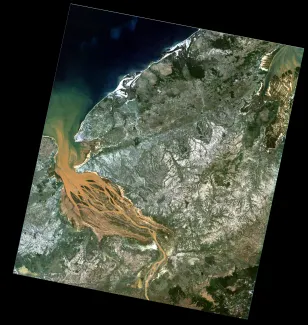
Hyperspectral satellite image taken by the IPERLITE mission above Mahajanga (North West of Madagascar) at 20260317T070809Z (UTC) and processed by VITO.
Looking Ahead: ESA’s Hyperspectral Biodiversity Scout Mission
The future of hyperspectral imaging is closely tied to global challenges, and biodiversity is one of the most urgent among them. Through its involvement in ESA’s HiBiDiS Scout mission, VITO is helping to push the boundaries of how we monitor ecosystems from space. By enabling highly detailed spectral measurements, HiBiDiS will provide new insights into vegetation and environmental health. Our contribution ensures that this data is not only captured, but also calibrated and processed to the highest standards, ready to support science, policy, and action.
Collaborations Enabling the New Space Economy
As the space sector evolves, new players and commercial initiatives are reshaping the landscape. VITO actively supports this transformation through collaborations such as our partnership with Simera Sense. By combining deep expertise in hyperspectral processing with innovative payload development, this collaboration helps bring advanced Earth Observation capabilities to a broader market, demonstrating how our heritage continues to create value in emerging ecosystems.
This expertise is already delivering tangible impacts. We supported LEMU in processing data from their Simera Sense hyperspectral payload as part of the LEMU NGE mission. By ensuring high-quality, calibrated data products, our team helped translate cutting-edge sensor technology into actionable environmental intelligence.
These collaborations highlight how VITO enables New Space actors to move faster from data acquisition to real-world impact, empowering a new generation of missions to fully leverage hyperspectral technology.
From Data to Intelligence: The Next Frontier
As hyperspectral missions generate ever larger volumes of data, the challenge is no longer just capturing information; it is making it usable, efficiently and in near real time. VITO is addressing this with onboard processing innovations such as CORSA, an AI-driven near-lossless compression solution designed specifically for Earth Observation data. By reducing data volumes by orders of magnitude while preserving critical information, CORSA enables faster delivery and more efficient use of satellite resources. Beyond compression, CORSA represents a shift toward intelligent data exploitation directly in orbit. Its foundation model not only optimizes data handling but also generates embeddings that are immediately ready for downstream applications. This opens the door to faster analytics, smarter data selection, and more autonomous decision-making, significantly enhancing the value of hyperspectral and multispectral missions. This shift toward onboard intelligence is a natural evolution of our expertise, extending from high-quality ground processing to advanced, AI-powered capabilities in space.
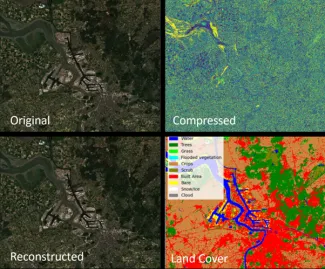
Comparison between the original and reconstructed satellite image using CORSA. A visualisation of the compressed feature space is shown, as well as the results of a small neural network trained on top of these features to predict land cover.
A Legacy That Shapes the Future
Across every mission described, from APEX to HyperScout-1, from IPERLITE to HiBiDiS and beyond, one constant defines our approach: uncompromising data quality.
Behind this consistency lies a unique combination of heritage and innovation. VITO’s CalibrEO and Image Processing Toolbox (IPT) bring together decades of expertise in calibration and processing into robust, scalable solutions. They ensure that hyperspectral data, whether acquired from airborne platforms or next-generation satellites, is accurate, consistent, and immediately usable.
More than technical frameworks, these solutions form the backbone that connects instruments to applications, transforming raw measurements into trusted insights. They enable mission operators, scientists, and commercial actors alike to rely on hyperspectral data with confidence.
As Earth Observation continues to evolve, our strength lies in the end-to-end capability, from sensor calibration to onboard intelligence and downstream analytics. By building on its long-standing expertise, VITO is uniquely positioned to support future hyperspectral missions and help partners unlock the full value of their data. From data to insight, VITO remains a trusted partner in shaping the future of hyperspectral Earth Observation.
Join Us at the 4S (Small Satellites Systems and Services) Symposium
Do you need AI for EO, edge computing, downstream applications, image quality, or hyperspectral instruments, solutions, services, and products for your next SmallSat mission? Join VITO at the 4S (Small Satellites Systems and Services) Symposium during 4-8 May 2026. Our Remote Sensing experts are looking forward to meeting you there and showing the Earth Observation solutions we are developing for a more sustainable planet. Or just contact us if you cannot make it to Sardinia